

Retirees overpaying super tax: Why up to 700,000 Australians pay more than they should
By Matt Linden, Super Members Council Australia Executive General Manager Strategy and Insights
Last updated 12 August 2026
Thousands of retirees are paying more tax than necessary because they haven’t switched their super into the tax-free retirement phase.
The Super Members Council (SMC) found that around 700,000 Australians over 65 who aren’t working full-time still have an accumulation (savings-phase) account.
This means retirees could be paying an extra $650 in taxes each year on average. Altogether, they have $90 billion in accumulation accounts.
This guide explains what the retirees’ superannuation tax hit is, why so many people are caught by it, and what to do if you think you’re one of them.
Table of contents:
- What is the retiree’s super tax hit?
- Why some retirees may still be paying tax on their super
- What to do if you have been affected by overpaying super tax
- Future financial advice reforms
What is the retiree’s super tax hit?
While you are building your super, your account sits in the accumulation phase, and the investment earnings inside it are taxed at up to 15%.
Once you move eligible savings into a retirement-phase account (an account-based pension), the Australian Taxation Office (ATO) does not tax those earnings at all.
This gap, so to speak, is where the super tax hits retirees, meaning that money left in the savings phase keeps being taxed as though you were still working.
- If someone keeps $100,000 in an accumulation account instead of moving it to a pension account, they could pay an up to extra $4,500 in super taxes over their retirement.
- For $200,000 balances, the extra tax could be $9,000.
However, the tax bill is only half the picture. A retirement-phase account may also change how much cash a retiree regularly receives.
SMC modelling in Retirement Revolution: Simpler, Smarter Retirement shows that a full-rate Age Pensioner with $50,000 in super who moved it into a retirement-phase account would lift their disposable income by about $2,200 a year (roughly $56,000 across their retirement).
With $100,000 in super, it’s an extra $4,000 a year, or about $115,000 across retirement.
The two sets of figures measure different things.
The $650, $4,500, and $9,000 amounts (mentioned above) are taxes you may be paying unnecessarily.
The $2,200 and $4,000 amounts are the extra income a full-rate Age Pensioner could have in hand (larger, because they reflect both the tax saving and the way retirement income is structured).
Download our ‘Retirement revolution’ report to see the full research on how Australians are managing their money in retirement.
Why some retirees may still be paying tax on their super
Not everyone with an accumulation account is making a mistake, and this is where things can get a little tricky.
Some inactive accounts belong to people who are still working and adding to other accounts, or who are keeping an accumulation account as a backup. For many others, though, it comes down to inertia: complex rules and simply not being sure what to do.
What the research tells us
A consumer survey of retirees found about 6 in 10 Australians with lower balances (less than $100,000) who have an inactive account keep it because they haven’t decided what to do with their super yet, or don’t know what to do with the account.
For retirees with low balances, the single biggest reason for leaving funds in the accumulation phase is that they don’t know what to do with it or how (39 per cent).
This is the group that would most benefit from super funds being able to offer simple and affordable advice relating to their retirement income, as a detailed financial plan may be too costly.
Chart 1: Reasons for inactive accounts for retirees with low, moderate, and high balances
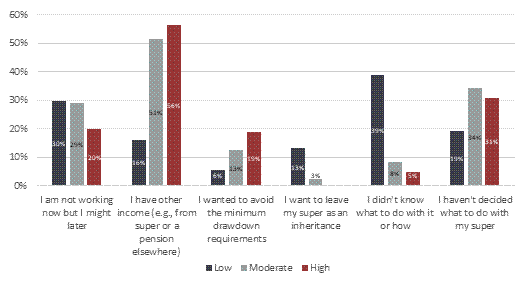
Notes: Question asks why individuals have left their super in accumulation and are not contributing to it. More than one reason can be selected. Reasons ‘Something else’ and ‘I don’t know’ have been excluded. Super balance range: low balances (less than $100k), moderate balances (between $100k and $400k) and high balances ($400k or greater).
Source: Susan Bell research commissioned by SMC, 2023.
A rule that forces some retirees to keep a taxed account
There is also a structural problem that has nothing to do with disengagement. Under current super rules, retirees who pick up some paid work, perhaps a few shifts or a bit of consulting, cannot pay those contributions into their retirement account.
They must open or maintain a savings-phase account to receive them, in which contributions and their earnings are taxed.
Escaping that tax means rolling the retirement balance back into a savings account and starting a new retirement account: administratively messy and potentially more fees.
SMC estimates around 100,000 Australian retirees are affected.
As part of our Simpler super for retirees work, we have recommended a legislative change to let contributions to be made straight into a retirement account.
What to do if you have been affected by overpaying super tax
If you are over 65 and still have super sitting in an accumulation account, it is worth checking your position. Four practical steps:
- Find out which phase your super is in. Log in to your fund or check your latest statement. It will tell you whether your money is in an accumulation (savings) account or a retirement-phase (pension) account.
- Check that you have met a condition of release. From age 65, you meet a condition of release automatically (whether or not you have stopped working). Before 65, you generally need to have reached your preservation age and told your fund you have retired.
- Talk to your super fund. Most funds can walk you through opening a retirement-phase account, and there is usually no cost to ask.
- Check the transfer balance cap. There is a lifetime limit on how much you can move into the tax-free retirement phase. It rose to $2.1 million on 1 July 2026. If you are near the cap, get advice before acting.
Simple retirement tax advice of this kind is exactly where the system is falling short.
SMC research shows only 17% of Australians (and just 26% of current retirees) have sought financial advice from their super fund. Treasury’s own analysis found 4 in 5 Australians aged 45–54 need financial advice but cannot afford it.
Super Members Council CEO Misha Schubert said that Delivering Better Financial Outcomes financial advice reforms will be crucial to help retirees access quality information at low cost.
“Not knowing enough about super can lead to poor decisions, like leaving accounts inactive or withdrawing funds without proper planning.”
“Making simple information and advice available to more Australians is a big missing piece of the retirement puzzle. The coming financial advice reforms will help make advice more affordable.”
Minimising taxes in retirement
Beyond moving your money into the retirement phase, a few settings are worth understanding when you are thinking about minimising taxes in retirement:
- Earnings are untaxed in the retirement phase. Investment earnings on money supporting an account-based pension are not taxed, compared with up to 15% in accumulation.
- Withdrawals from age 60 are generally tax-free. For most people, both pension payments and lump sums from a taxed super fund are tax-free once you turn 60.
- You must draw a minimum each year. A retirement-phase account has a minimum annual drawdown (5% of your balance for most people aged 65 to 74, rising with age). It is an income stream, not a place to park money untouched.
- The transfer balance cap applies. Amounts above the cap ($2.1 million from 1 July 2026) must stay in accumulation, where earnings are taxed.
- Sometimes keeping an accumulation account is the right call. If you are still working and receiving contributions, you may need one. The point is to make it a decision, not an oversight.
This is general information, not personal financial advice. Your own circumstances, including any Age Pension entitlement, will shape the right answer for you.
Subscribe to our Super Wrap newsletter to receive curated super updates and to be notified of upcoming events.
Future financial advice reforms
Australia’s Future of Financial Advice (FOFA) rules introduced important protections for consumers, including the requirement to act in clients’ best interests. However, the rules and paperwork involved can make even simple advice costly.
That can be a poor fit for a retiree with $60,000 in super who only wants to know whether to move it into a retirement-phase pension.
The government’s Delivering Better Financial Outcomes (DBFO) package is the current attempt to close that gap.
Two elements matter most here:
- Targeted prompts from super funds. The reforms would allow super funds to better guide members at key life stages with personalised prompts to support them for retirement – including a nudge to consider moving into the retirement phase.
- A new class of adviser. The package would also create a new type of adviser who can give simple but quality advice on APRA-regulated products at a far lower cost than a full financial plan.
The first stage of DBFO is law.
The remaining stages, including the targeted prompts and the new class of adviser, were still before the government at the time of writing, with the design of the new adviser category continuing to be debated. SMC has urged the government to move quickly.
“The package of reforms will enable the 2.5 million Australians on the runway to retirement to get the high-quality information they need to plan wisely at a much lower cost – and we urge the Government to introduce legislation swiftly.” Misha Schubert, SMC CEO
Until those reforms land, the responsibility sits with retirees to ask the question themselves. If your super is still in a savings-phase account and you have stopped working full-time, it is a five-minute call to your fund (and it could be worth thousands).
Download our ‘Retirement revolution’ report for SMC’s full roadmap to a simpler, smarter retirement system, and subscribe today to get updates as the advice reforms progress.
About the author
Matt Linden
Super Members Council Australia Executive General Manager Strategy and Insights

Matt is responsible doe evaluating the constantly changing environment in super and identifying strategies and value creating activities across the organisation to enhance and protect the retirement savings of members.
See more about Matt: Our team
Sources consulted
Australian Taxation Office (ATO)
- Withdrawing and using your super — https://www.ato.gov.au/individuals-and-families/super-for-individuals-and-families/super/withdrawing-and-using-your-super
- Retirement withdrawal – lump sum or income stream — https://www.ato.gov.au/individuals-and-families/super-for-individuals-and-families/super/withdrawing-and-using-your-super/retirement-withdrawal-lump-sum-or-income-stream
- Tax on super benefits — https://www.ato.gov.au/individuals-and-families/super-for-individuals-and-families/super/withdrawing-and-using-your-super/tax-on-super-benefits
- Payments from super (key rates and thresholds) — https://www.ato.gov.au/tax-rates-and-codes/key-superannuation-rates-and-thresholds/payments-from-super
- Transfer balance cap — https://www.ato.gov.au/tax-rates-and-codes/key-superannuation-rates-and-thresholds/transfer-balance-cap
Government and regulatory
- ASIC — Delivering Better Financial Outcomes (DBFO) package — https://www.asic.gov.au/regulatory-resources/financial-services/regulatory-reforms/delivering-better-financial-outcomes-dbfo-package/
- Treasury — DBFO publication — https://treasury.gov.au/publication/p2024-607305
- Minister Stephen Jones — media release on accessible, safe, quality advice — https://ministers.treasury.gov.au/ministers/stephen-jones-2022/media-releases/ensuring-australians-can-access-safe-quality-and
- Services Australia — Age Pension — https://www.servicesaustralia.gov.au/age-pension